

drscoop
-
Posts
79 -
Joined
-
Last visited
-
Days Won
1
Recent Profile Visitors
2,677 profile views




drscoop's Achievements






-
I think this is the way forward. It can go waaaay up theDMX and fixture list and always be dark. The scrollers will only ever move the other “real” fixture is dark, so it shouldn’t go rogue if the dummy one is never lit…. I think!!
-
I think this is what we’ll do next time - presently they’re set so we can apply asymmetric colour washes to the stage… so each one can be controlled individually. I’d hoped there may be a fix so that we could use 1 DMX address for the lamp but then add in 2 addresses for the scrollers. Using dummy fixtures may be the way forward if we want to retain this feature….
-
Anyone know I how can I force a scroller to move on dark when it’s not a standard “‘lamp+1” fixture, but the scroller is a standalone fixture - and how to link to it’s dimmer channel so the desk knows when it is dark, if it’s not a straightforward patch? For context, I’m helping out a new theatre group and using scrollers for the first time in an FLX S. The rig has some pairs of tungsten fixtures wired back to the same dimmer channel, but the pairs of scrollers have their own DMX address, so I can’t use the multiple part standard fixtures as I need 1 dimmer channel but 2 independent scroller channels for each set of paired fixtures… I am using the generic “scroller” 1ch fixture on the desk and can build colour palettes etc but can’t work out how best to patch this to link to intensity to move the scrolls on dark. I kinda need a fixture that has 1 ch for intensity, but 2 channels, ideally individually selectable, for the two scrollers… Is there a workaround here? Thanks in advance…
-
ZerOS 7.14.3 Released and ZerOS 7.15 Coming Soon!
drscoop replied to Jon Hole's topic in News & Announcements
Thanks, Edward - so with no extra hardware it’s effectively a free upgrade to a 1024 channel desk? Most helpful! will the playback and channel button LEDs effectively work in binary to show the page (0,0; 0,1; 1,0; 1,1?) vs the current 1-24; 25-48 LED? -
ZerOS 7.14.3 Released and ZerOS 7.15 Coming Soon!
drscoop replied to Jon Hole's topic in News & Announcements
I’m very pleased to hear of the upgrades to FLX S in 7.15 but interested how it’ll translate in practice. For our FLX S24, am I right in thinking both outputs will be enabled to generate a universe per output (as I understood the paid upgrade worked) or will this need some form of LAN breakout? I assume this would have to be the case to get all four universes? Similarly with the playbacks, I wondered how this will implement with only 48 physical playbacks available? Regardless, the increased groups and palettes will be very helpful! -
Is is possible to map two single DMX channels to a single fixture fader? (Other than by writing a bespoke fixture profile, perhaps?) I have a four channel DMX dimmer in an upcoming rig, set up as 4 x generic single dimmer channels starting @ DMX address 255 - chs 256 and 257 will control two lamps within an old ripple effect, and ch258 will control motor speed. I'd ideally like one channel fader to operate both dimmer channels together (i.e. bind together DMX 252 and 253), and the adjacent channel fader mapped to the motor @ DMX 253. The dimmer is only fairly low ampage so I can't just Grelco the two 15A tails together on a single channel - I wondered if I can do this virtually on the desk?
-
Thanks Edward, you're right. Fixture 11 had been deleted somewhere along the line, and I'd not spotted that!
-
Hi, This may be a trivial thought, but is it possible to scale the font on the output window? Phantom ZerOS and, I think, our FLX S 24 shows 13 fixtures per row and I wonder if it can be scaled to show 12 per row, so each row mirrors the physical desk layout? I've seen other desks @ 12 wide and wondered how to change the scaling? Thanks!
-
Hi, Am I right that the FLX S desks don't support MIDI in, for example to trigger playbacks via a Launchpad or similar? I wondered if there was any alternate way to create a more "buskable" surface for mini festivals etc.?
-
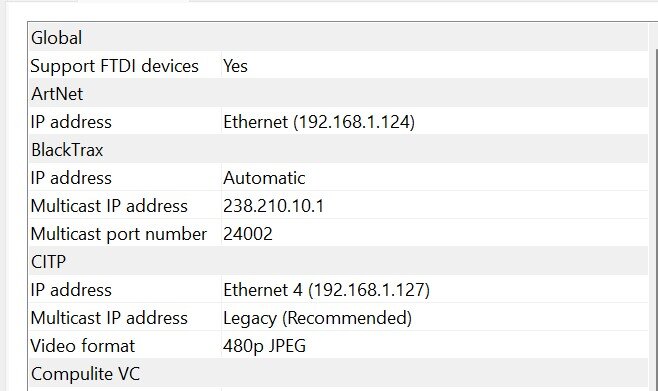
Thanks again Edward - that'd explain why I couldn't get anything with sACN or Art-Net! For Capture, I was referring to what I think is the IP address Capture "listens" to for output from PhantomOS. I think we're talking about the same thing with different terms... Appreciate there may be a more elegant/correct terminology... The good news is, using the localhost Loopback IP, I now have control of my showfile using Phantom ZerOS again...
-
Thanks Edward, Just to clarify, the desk and PC are on different IPs but the Capture "listen" IP and the desk "broadcast" IPs matched... my poor choice of phrasing. I also tried with both static IPs and with DHCP-assigned addresses to no avail... I'm intrigued to check if Phantom ZerOS 7.10 works (I suspect not, as I think it's a Capture listening issue as all other connectivity works robustly) and whether a fresh Capture install helps. I did try a new Capture show file, in case my showfile had corrupted, but that didn't help either... I also need to check what happens if I use the loopback IP when Capture and Phantom ZerOS are on the same PC - if I can get that working OK, I can get on with some show file work, and worry about desk/Capture connectivity later... I had the desk and laptop running Capture connected by direct Cat5 and also then over a dedicated wifi network, but with Capture restricted to listen to the broadcast IP reported by the desk, I got no response. Interestingly, Capture showed some of the luminaires already on (I expected as there as no fixtures selected and outputting on the desk the showfile would be dark) whether there was some disconnect in the DMX addressing, though nothing looked obvious. I'm also a little intrigued - as the desk can output sACN and ArtNet, and Capture can receive both of these, is it possible to connect the two systems using a protocol other than CITP? I'll keep noodling away and report back. It's odd that it was working ok recently, but not after the switch to 7.11, but I feel that may be co-incidental.
-
I'm probably missing something silly/obvious, but has anyone any thoughts on connecting an FLX S24 to Capture 2019 Solo (licensed) on 7.11? It seemed to work fine previously on 7.10 but now I cannot seem get my desk, or Phantom ZerOS, to talk to Capture. I have previously found that Capture is always a bit of a faff when it comes to connectivity, but I've just spent a frustrating 2 hr trying all I can think of to get a show working in the visualiser. I have tried: - desk to PC via ethernet router, checking Capture IP and desk broadcast IP match - Desk over wifi router with matched IPs - PC with PhantomOS to Capture on the same machine (IPs checked an correspond ok) - Laptop with PhantomOS to Capture on the same machine (IPs checked an correspond ok) - Desk on wifi to Capture on laptop on same network, with both static IPs or with DHCP enabled In all cases, the ZerOS remote apps all work fine, so the desk and laptop/PC are talking, and the network status shows that the desk is transmitting CITP, but Capture will not recognise any desk input. It seems to be a Capture listening issue, I think. I've also tried starting at CITP Universe 0 or 1, and also tried Streaming ACN and ArtNET for connectivity, all to no avail... I've run out of things I can think of to try... any suggestions warmly welcomed.
-
Thanks Edward. I tohught I did the Z . to break the channels up, but will try again. I could certainly get colour effects runnig independently across the eight LED groups, but was strugglnig if they were just white... Always good to hae new things to learn and explore
-
It's an LEDJ tri-colour STAR13 RGB star cloth, in 28ch mode. The manual won't attach ("Max file size of 20 kB exceeded") but a copy is here: https://prostage.no/media/multicase/documents/pdf prolight uk/star13_manual.pdf We were using the ProLight LEDJ Starcloth System profile. The profile only seems ot have master intensity - I guess this might be the issue but I wondered if there was a way to control individual cell intensities? Maybe a custom effect across the RGB channels, offset by cell, created on an FLX and transferred across via a showfile?
-
Yep, that video was very helpful as we were programming, but I didn’t see a way on our cloth to control per-cell intensity. Maybe specific to the fixture profile in that it sees the cloth as a non-linear fixture. With “show intensity on wheel 1” enabled, selecting one of the cells did not give me an intensity encoder as expected…. In the end I made a chase across the cells, and ran it off a playback, which worked but took a little longer than just tapping an intensity effect…